Second Opinion: Letting Claude and ChatGPT hash it out
Get this skill
A Claude Code skill that has Claude and ChatGPT review your work, debate each other’s edits, and hand back what they agree on. Free on GitHub.
When I’m working on something important, especially something with a lot of moving parts, I’ve found it’s best to get feedback from both Claude and ChatGPT. I share the original with both, then take the feedback or edits I get from one and share them with the other, essentially saying “here are some edits and feedback I got.” The other one will usually come back with notes of its own, and around we go, with me as the copy-and-paste messenger between the two.
Each one has great notes, and they will often challenge what the other said, admit the other one’s version is stronger, or make improvements that are completely different and new. The latest models are both strong but still have quite different personalities and approaches, kind of like working with two very smart people. The process is incredibly valuable, though it’s quite tedious to do myself.
Recently I was working on an LOI and asked Claude if it could take the document and continue the process directly with ChatGPT, going back and forth on its own, and let me know if any questions came up and what the end result was. It turns out it could, and that’s how this skill came about. I call it second-opinion, and it lets Claude and ChatGPT hash it out on their own, for up to three rounds, until they reach a consensus. It has been an absolute game changer.
How it works
- I share the draft, or whatever the first version of the work is.
- Claude and ChatGPT each write their own review without looking at each other’s.
- Then Claude and ChatGPT actually discuss and debate each other’s changes.
- I get back the outcome, which is their suggested edits plus any decisions left for me.
A few things I learned along the way:
- Three rounds has been plenty. If they still disagree after three, it’s almost always a judgment call that is mine to make anyway, so I would rather see both positions than have them keep going. The limit also keeps them from being too polite. Both of them are agreeable by nature, and if you let them go long enough they will find a way to agree, so every message Claude sends includes the line “Do not agree to be agreeable. If you still think I’m wrong, say so.”
- Neither one is allowed to edit the document while they’re going back and forth. ChatGPT only gets read-only access, so it can’t change any of my files, and any changes happen afterward once I’ve seen the outcome.
- Every round gets saved as its own file and nothing is deleted afterward, so there’s a full record of the discussion. I can go back and see what was decided along the way, and which of the two argued for what.
- The disagreements are often the most useful part for me, because they show me where the real tradeoffs are.
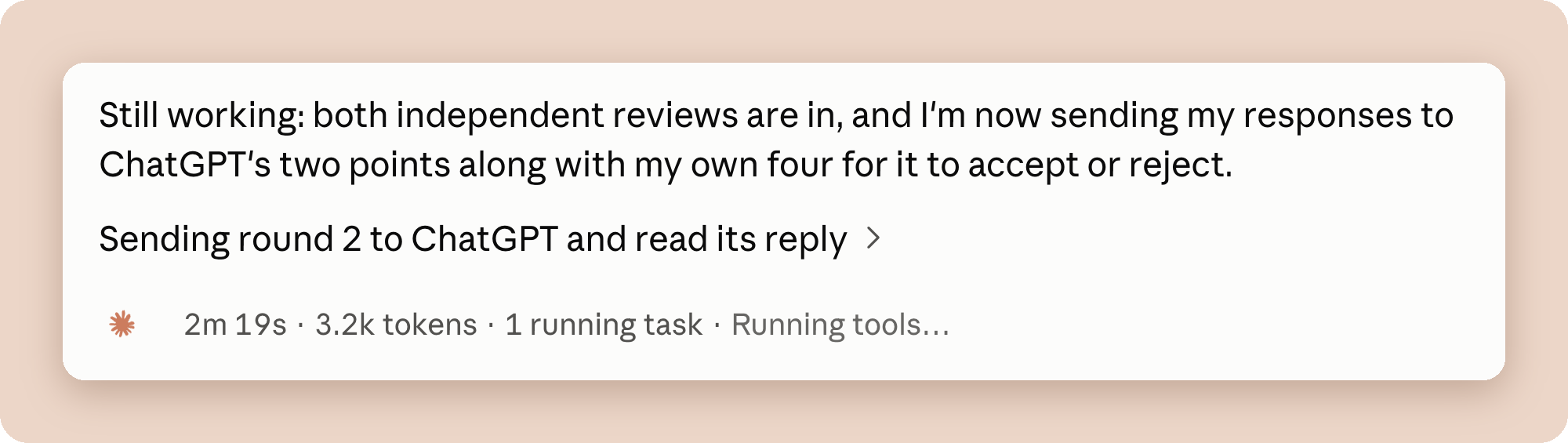
Here’s what it looks like in Claude Code partway through:
What it’s built with:
- Claude Code, which runs the whole exchange
- Codex, OpenAI’s tool for using ChatGPT from the command line, which is how Claude reaches ChatGPT. It’s signed in with my regular ChatGPT account, so it draws on the subscription I already pay for, with no API key to set up and no pay-as-you-go API credits to buy on top.
- A Claude skill, which is really just a page of instructions and a few small scripts
- Obsidian (optional), where I already keep all my notes and drafts, so that’s where the final note shows up for me. Without it, the note just lands next to your document.
It’s a little funny to read two AIs politely disagreeing with each other about my work, and I’m glad I’m no longer the one copying and pasting in the middle. If you’d like to try this yourself, the skill is on my GitHub.